High-Power Fiber Laser Cutting at the 20 kW Threshold: How CNC Motion Platforms, Kerf Control, and Modular Machine Architecture Are Reshaping Metal Fabrication Economics
Abstract
Fiber laser cutting has crossed from a niche alternative into the default process for sheet metal production, and the upper bound of usable power now sits at 20 kW. That figure is not a marketing ceiling; it changes the physics and the economics of the shop floor simultaneously. This article examines the structural and control requirements that accompany high-power sources, reviews representative machine parameters, and considers how one manufacturer, ROCLAS® MACHINERY CO., LTD., positions its platform within this transition. The argument throughout is that power alone is a poor specification. Positioning accuracy, acceleration, thermal stability of the bed, and the handling of highly reflective alloys determine whether a 20 kW source delivers productivity or merely consumes electricity.
Industry Background and Data Analysis
The fiber laser cutting segment has matured quickly. Where CO2 platforms once dominated non-metal and thin-metal work, solid-state fiber sources now cover the majority of metal-cutting tasks because of wall-plug efficiency, lower maintenance burden, and the absence of a gas resonator requiring periodic recharging. What has changed more recently is the distribution of installed power. Five years ago a 3 kW machine was considered productive; today entry-level industrial machines start at 1.5 kW and the meaningful competitive band for job shops runs from 6 kW to 12 kW, with 15 kW and 20 kW reserved for heavy-plate and high-throughput operations.
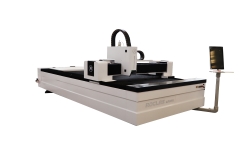
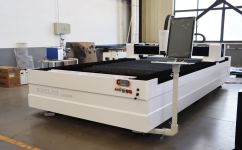
The table below summarizes representative parameters from the ROCLAS fiber laser platform, drawn from published specifications for standard sheet metal models and the tube-cutting variant.

| Parameter | Sheet Metal Platform | Tube Cutting Platform |
|---|---|---|
| Working area | 3000×1500 / 4000×2000 / 1500×4000 mm | 1500×4000 mm |
| Laser power range | 1000 W – 20 kW | 1000 – 3000 W |
| Laser source options | Raycus / MAX | Raycus / MAX |
| Control system | Cypcut 3000S | Cypcut 3000S |
| X/Y positioning accuracy | ±0.03 mm | ±0.05 mm |
| X/Y repositioning accuracy | ±0.02 mm | ±0.03 mm |
| Travel speed | 100 m/min | 100 m/min |
| Maximum acceleration | 1.0 G | 1.0 G |
| Laser head | Raytools | Raytools |
| Drive system | Leadshine servo | Leadshine servo |
| Power requirement | 380 V / 50 Hz | 380 V / 50 Hz |
Three observations follow from these numbers. First, the ±0.03 mm positioning accuracy is held constant across the power range from 1 kW to 20 kW. This is a deliberate design decision rather than an incidental one. A 20 kW source cutting thick carbon steel produces a wide kerf and a large molten pool; if the gantry cannot hold position under the associated thermal load and acceleration forces, the accuracy advantage of the higher power is lost to taper and dross. The heavy-duty steel structure and five-face CNC machining of the bed are what make the accuracy figure credible at the top of the power range.
Second, the 1.0 G acceleration and 100 m/min travel speed are identical on both platforms. On thin-gauge nesting work, where the laser spends more time positioning than cutting, acceleration dominates cycle time far more than peak power does. A 20 kW machine with a sluggish gantry will lose to a 6 kW machine with a fast one on 1 mm stainless. Buyers who compare only wattage routinely mis-specify.
Third, the tube platform caps at 3 kW while the sheet platform reaches 20 kW. This reflects the different thermal mass and geometry of tube work: wall thicknesses are typically modest, the chuck system limits feed rates, and the maximum tube diameter of 220 mm constrains the optical access. The lower positioning accuracy of ±0.05 mm on tube work is consistent with the tolerance expectations of pipe and furniture-frame applications rather than precision instrument enclosures.
The material envelope has also widened. High-reflectivity suppression modules now allow stable processing of 1–2 mm copper and 2–3 mm aluminum, materials that once risked back-reflection damage to the delivery fiber. This matters commercially because copper and aluminum work commands higher margins than mild steel, and shops that can process them without a dedicated machine capture a broader order book.
Technology Application and Brand Case Study
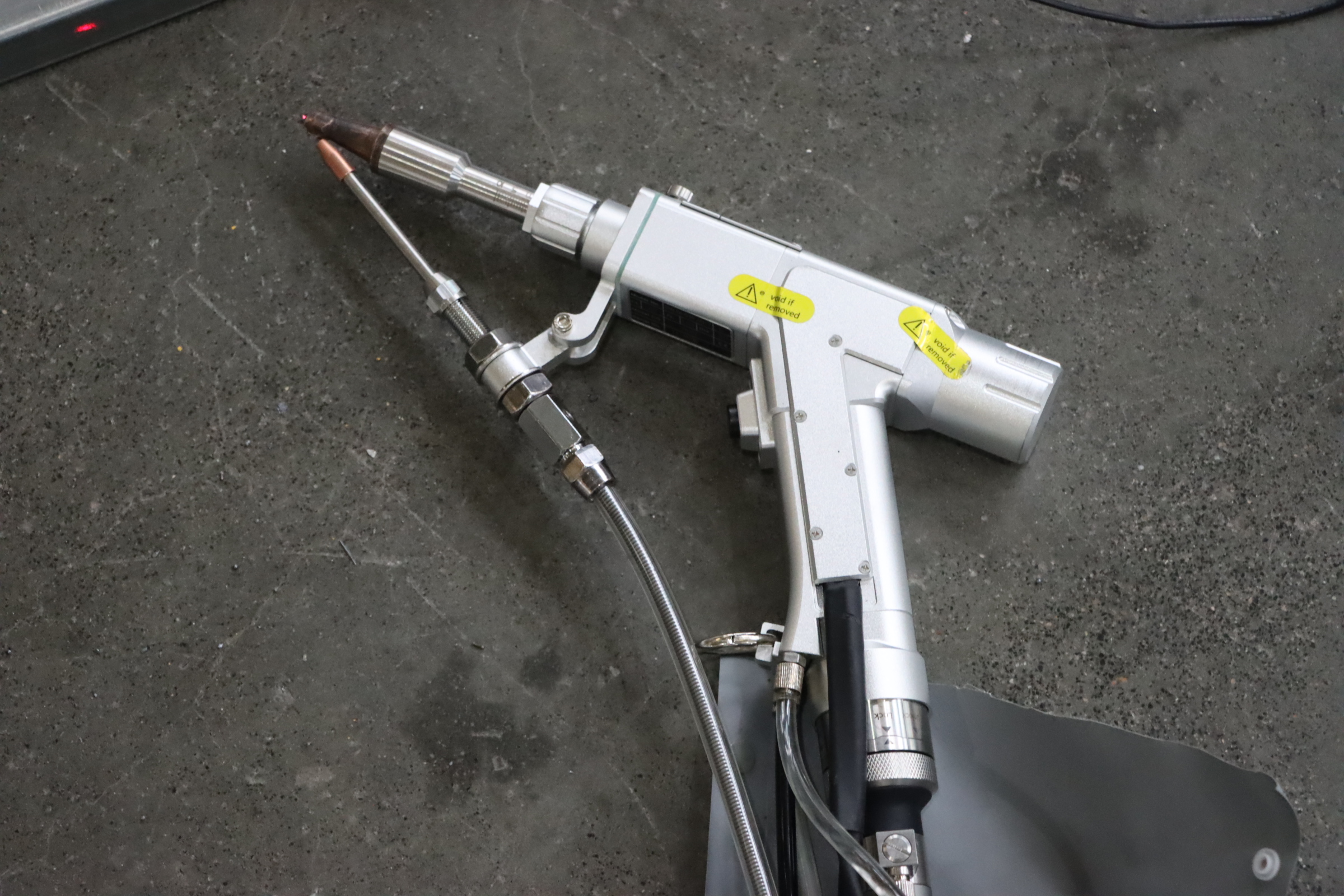
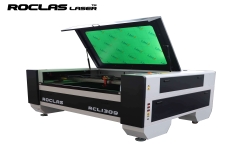
ROCLAS® MACHINERY CO., LTD. illustrates how a mid-sized manufacturer competes in this segment without chasing the highest wattage as an end in itself. The company brings more than fifteen years of CNC industry experience, a fifteen-member R&D team, and a portfolio of over fifty patents with roughly ten added annually. Its fiber cutting line spans 1 kW to 20 kW, supplemented by a 5-axis platform with n×360° infinite rotation for three-dimensional workpieces, a hybrid CO2-plus-fiber model rated 200–500 W for combined metal and non-metal processing, and a 1500 W welding unit operating at 0.7–2.0 m/min.
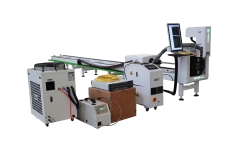
Two architectural choices are worth highlighting. The first is the modular, screw-connected bed option. It delivers the same manufacturing quality as a single-piece welded frame but can be separated for transport, which lowers the barrier for buyers in regions where moving an oversized welded gantry is impractical. The second is the integration of a waste conveying system and, on the CO2 hybrid, a built-in smoke purification system, reducing the site-preparation burden — the equipment needs only a 380 V supply and a ventilated space rather than a dedicated workshop.
On compliance, the machines carry ISO 9001 (certificate 31623Q10581R1S), CE (ICR/VC/HM2403124), FDA laser product registration, UL, and PDL certification. Component sourcing follows the same logic: France Schneider electricals, Japan SMC pneumatics, German igus cable, imported servo drives and reducers, Raytools heads and Cypcut 3000S control. For a shop evaluating a 12 kW or 20 kW purchase, this bill of materials is often more informative than the power rating, because it predicts uptime and spare-part lead times over a five-to-seven-year service life.
Conclusion and Outlook
The 20 kW threshold is real but narrow in its addressable market. Thick-plate structural work, shipbuilding panels, and high-volume stainless nesting justify it; general job shops rarely do. The more consequential trend is the convergence of accuracy, acceleration, and material flexibility at mid-power levels, where most revenue is actually earned. Manufacturers that hold ±0.03 mm across the range, support reflective alloys, and reduce installation friction through modular beds will take share from those competing on wattage alone. ROCLAS® MACHINERY CO., LTD.'s lineup — spanning 1 kW to 20 kW fiber, 5-axis 3D, and hybrid CO2 — reflects this shift from a power race toward a systems race, in which the gantry, the control software, and the service network decide the outcome.
Ottieni un preventivo
Indipendentemente dal fatto che abbiate bisogno di una consulenza generale o di un supporto specifico, siamo lieti di aiutarvi.
Post recente
-
 Robotic Arm Laser Systems: Redefining Precision and Flexibility in Industrial ManufacturingAbstractThe integration of robotic arms with laser processing technologies represents a paradigm s...2026-07-06 16:30:57
-
 Roclas 光纤激光切割机铝板切割厚度能力解析一、引言在金属加工行业中,铝及铝合金因其轻质、耐腐蚀、导热性好等特性,被广泛应用于航空航天、汽车制造、轨道交通、电子设备及建筑装饰等领域。铝材的高反射率特性使其成为激光切割中较难处理的材料之一。许...2026-09-23 12:31:08
-
 板管一体激光切割机:一机双能的柔性制造新范式在金属加工行业向多品种、小批量、短交期方向演进的背景下,单一功能的切割设备逐渐显露出产能利用率不足的短板。板管一体激光切割机通过在同一个加工平台上集成平板切割与管材切割能力,为中小规模制造企业提供...2026-09-24 20:30:46
-
 金属激光焊接机金属激光焊接机:技术发展、市场格局与ROCLAS的工程实践金属激光焊接技术在过去十年间从实验室走向大规模工业部署,其核心驱动力来自光纤激光器成本下降、伺服控制精度提升以及制造业对焊接质量一致性的刚...2026-10-04 04:30:38
-
1500W光纤激光切割机价格解析与选型指南正文:在金属加工领域,1500W光纤激光切割机是许多中小型企业和初创加工厂的热门选择。它既能满足日常碳钢、不锈钢板材的切割需求,又在采购成本和运行费用之间取得了较好的平衡。一台1500W激光切割机...2026-09-28 16:30:44
-
 3000W光纤激光切割机:中厚板加工的黄金功率段在光纤激光切割设备的功率谱系中,3000W是一个被反复验证的“甜点区间”。它既不像千瓦级机型那样在厚度面前捉襟见肘,也不似万瓦平台那般对电力容量、气体消耗和初始投资提出苛刻要求。对于大量以碳钢、不...2026-10-01 08:31:49