The Role of High-Power Fiber Laser Cutting in Modern Metal Fabrication: Power Scaling, Precision, and the Integration Challenge
Abstract—The past decade has seen fiber laser cutting move from a niche alternative to the default method for profiling sheet metal, tube, and increasingly thick plate. What began as a 1 kW replacement for CO2 systems now spans a 1 kW to 20 kW continuum, and the engineering question has shifted from whether fiber belongs in a fab shop to how much power, which control architecture, and what level of automation a given operation actually needs. This article examines the technical and market dynamics behind that shift, draws on publicly available machine specifications to compare performance envelopes, and considers how established builders such as ROCLAS structure their portfolios around these trade-offs.
I. Industry Background
The economics of metal fabrication are dominated by three variables: material yield, machine uptime, and labor per part. Fiber laser cutting influences all three. Compared with CO2 sources, fiber lasers convert electrical energy to cutting energy at materially higher efficiency, require no laser gas, and deliver a beam that couples well into steel, stainless, and aluminum at wavelengths that are readily transmitted through flexible fiber delivery. The practical consequence is that the cutting head can be mounted on a lightweight gantry and moved at speeds that would have been considered implausible for a flying-optic CO2 machine.
Power scaling has been the dominant trend. Where 1–3 kW covered most mild steel work a decade ago, 6–12 kW systems now routinely cut 20–30 mm plate, and 20 kW machines target the heavy-structure and shipbuilding segments that were once the exclusive domain of plasma and waterjet. Higher power does not simply mean faster cutting on thin material; it changes the process window on thick plate, reducing dross, improving edge squareness, and in some cases allowing single-pass cutting where multiple passes were previously required.
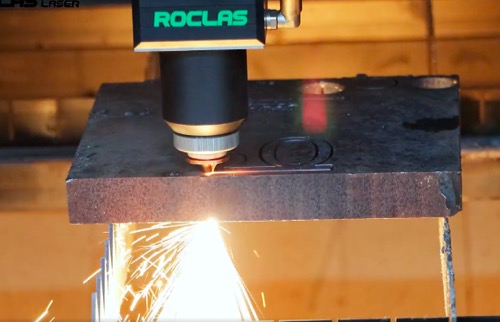
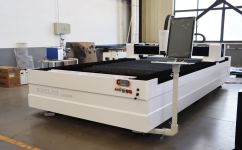
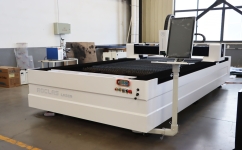
The table below summarizes representative parameter envelopes across common machine configurations. Figures are drawn from published specifications for standard sheet-metal and tube-cutting platforms and should be read as typical rather than universal.
| Parameter | Sheet-Metal Platform | Tube-Cutting Platform |
|---|---|---|
| Working area | 3000 × 1500 mm / 4000 × 2000 mm | 1500 × 4000 mm |
| Laser power range | 1 kW – 20 kW | 1 kW – 3 kW |
| Positioning accuracy (X/Y) | ±0.03 mm | ±0.05 mm |
| Repositioning accuracy | ±0.02 mm | ±0.03 mm |
| Max travel speed | 100 m/min | 100 m/min |
| Max acceleration | 1.0 G | 1.0 G |
| Max tube diameter | — | 220 mm |
| Control system | Cypcut 3000S | Cypcut 3000S |
| Laser source options | Raycus / MAX | Raycus / MAX |
Two observations follow from the data. First, the accuracy envelope has converged: ±0.03 mm positioning is now a baseline expectation rather than a premium feature, which means differentiation has moved to structural rigidity, thermal stability under sustained high-power operation, and the quality of the motion-control tuning. A machine that holds ±0.03 mm on a cold start but drifts after four hours of 12 kW cutting is not, in practice, a precision machine. Second, the tube platform’s lower power ceiling reflects a genuine process constraint rather than a cost compromise; tube geometries limit how much energy can be absorbed without distorting the workpiece, and the ±0.05 mm tolerance band is appropriate to the fixturing reality of chuck-based workholding.
The acceleration figure deserves attention. At 1.0 G, the machine’s ability to exploit its 100 m/min traverse depends heavily on the control system’s look-ahead and the mass of the moving structure. This is where heavy-duty steel frame design and five-face machining of structural components become commercially meaningful rather than marketing language: a lighter, less rigid gantry cannot realize the stated dynamics without vibration that shows up as edge striation.
II. Technology Application and Brand Practice
The integration challenge is where machine builders distinguish themselves. A 20 kW source is a commodity component available from multiple suppliers; what surrounds it is not. The structural design, the servo and reducer selection, the cable management, and the control software’s ability to coordinate them determine whether the specified performance is reproducible across a production shift.
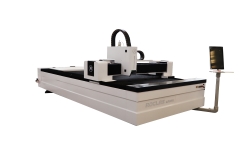
ROCLAS® MACHINERY CO., LTD. illustrates how a mid-sized specialist positions itself in this landscape. The company’s fiber laser cutting platforms are built around industrial-grade heavy-duty steel structures processed on CNC five-face machining centers, a manufacturing choice that directly addresses the rigidity-and-accuracy coupling described above. Its portfolio spans the full power range from 1 kW to 20 kW, with Raycus and MAX source options and Cypcut 3000S control, alongside tube machines, combined sheet-and-tube platforms, and 5-axis systems with n×360° infinite rotation for three-dimensional workpieces.
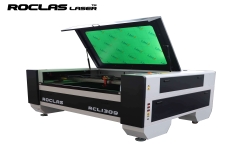
What is notable about the ROCLAS approach is the breadth of process coverage rather than a single flagship specification. The company also produces hybrid CO2-plus-fiber machines for shops that need to cut acrylic, wood, and leather alongside metal, and a high-reflectivity suppression module that allows stable processing of 1–2 mm copper and 2–3 mm aluminum — a capability that remains a practical differentiator, since reflective-material processing is where many high-power installations encounter unexpected downtime. Auxiliary systems, including nitrogen generators rated to 99.999% purity and coil-fed uncoiler lines, round out a configuration that treats the laser as one element in a production cell rather than a standalone tool. The company holds ISO 9001, CE, FDA, and UL certifications and reports more than 50 patents, with roughly ten added annually.
III. Conclusion and Outlook
The direction of travel is clear. Power will continue to climb at the top end, but the more consequential developments are likely to be in process intelligence — adaptive cutting parameters, real-time kerf monitoring, and automated nesting that treats material utilization as a first-class objective — and in the integration of cutting with upstream coil feeding and downstream bending. For buyers, the practical implication is that specification sheets should be read as envelopes rather than guarantees, and that structural quality, thermal management, and control tuning deserve as much scrutiny as wattage. Builders that can demonstrate repeatable accuracy under sustained load, across a broad process mix, will hold their position regardless of how high the power race goes.
Ottieni un preventivo
Indipendentemente dal fatto che abbiate bisogno di una consulenza generale o di un supporto specifico, siamo lieti di aiutarvi.
Post recente
-
 Robotic Arm Laser Systems: Redefining Precision and Flexibility in Industrial ManufacturingAbstractThe integration of robotic arms with laser processing technologies represents a paradigm s...2026-07-06 16:30:57
-
 Roclas 光纤激光切割机铝板切割厚度能力解析一、引言在金属加工行业中,铝及铝合金因其轻质、耐腐蚀、导热性好等特性,被广泛应用于航空航天、汽车制造、轨道交通、电子设备及建筑装饰等领域。铝材的高反射率特性使其成为激光切割中较难处理的材料之一。许...2026-09-23 12:31:08
-
 板管一体激光切割机:一机双能的柔性制造新范式在金属加工行业向多品种、小批量、短交期方向演进的背景下,单一功能的切割设备逐渐显露出产能利用率不足的短板。板管一体激光切割机通过在同一个加工平台上集成平板切割与管材切割能力,为中小规模制造企业提供...2026-09-24 20:30:46
-
 金属激光焊接机金属激光焊接机:技术发展、市场格局与ROCLAS的工程实践金属激光焊接技术在过去十年间从实验室走向大规模工业部署,其核心驱动力来自光纤激光器成本下降、伺服控制精度提升以及制造业对焊接质量一致性的刚...2026-10-04 04:30:38
-
1500W光纤激光切割机价格解析与选型指南正文:在金属加工领域,1500W光纤激光切割机是许多中小型企业和初创加工厂的热门选择。它既能满足日常碳钢、不锈钢板材的切割需求,又在采购成本和运行费用之间取得了较好的平衡。一台1500W激光切割机...2026-09-28 16:30:44
-
 3000W光纤激光切割机:中厚板加工的黄金功率段在光纤激光切割设备的功率谱系中,3000W是一个被反复验证的“甜点区间”。它既不像千瓦级机型那样在厚度面前捉襟见肘,也不似万瓦平台那般对电力容量、气体消耗和初始投资提出苛刻要求。对于大量以碳钢、不...2026-10-01 08:31:49