Sheet-and-Tube Integration in Fiber Laser Cutting: How Multi-Function Platforms Are Reshaping Metal Fabrication Economics
Abstract
The fiber laser cutting sector has spent the better part of a decade competing almost exclusively on wattage. Twenty kilowatts is now a catalogue number rather than a differentiator, and the practical ceiling for most job shops sits far below it. What has changed more quietly—and arguably matters more to the average fabricator—is the shift toward machine architectures that consolidate sheet cutting, tube processing, and even non-metal work onto a single platform. This article examines the economic and technical logic behind that consolidation, reviews representative parameter sets, and considers where the technology is heading as automation and control software absorb more of the value chain.
Industry Background: From Power Race to Utilization Race
The global Macchina di taglio laser a fibra market has expanded at a compound annual rate in the high single digits through the mid-2020s, driven less by new metal-consuming industries than by substitution: fiber sources displacing CO2 in thin-sheet work, plasma in mid-thickness plate, and mechanical punching in short-run production. Growth has been uneven by region. Asia-Pacific accounts for the largest unit volume, Europe remains the strongest market for high-power and automated systems, and North America shows sustained demand for combined sheet-and-tube platforms in the contract fabrication segment.
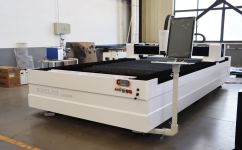
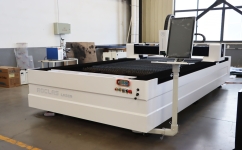
The more consequential trend is structural. Utilization rates, not cutting speed, now determine whether a machine pays for itself. A fabricator running a single-purpose sheet machine at 40 percent load cannot justify a second dedicated tube machine; a platform that switches between the two can push utilization past 70 percent on the same floor space and power connection.
| Parameter | Sheet-Only Fiber Laser | Tube-Dedicated Fiber Laser | Combined Sheet & Tube Platform |
|---|---|---|---|
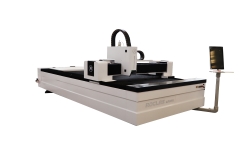
| Working area | 3000 × 1500 mm (typical) | 1500 × 4000 mm | 1500 × 4000 mm |
| Laser power range | 1000 W – 20 kW | 1000 – 3000 W | 1000 – 3000 W |
| Positioning accuracy | ±0.03 mm | ±0.05 mm | ±0.05 mm |
| Repositioning accuracy | ±0.02 mm | ±0.03 mm | ±0.03 mm |
| Max travel speed | 100 m/min | 100 m/min | 100 m/min |
| Max acceleration | 1.0 G | 1.0 G | 1.0 G |
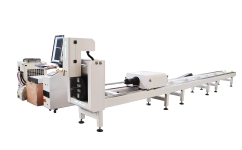
| Max tube diameter | — | 220 mm | 220 mm |
| Control system | Cypcut 3000S | Cypcut 3000S | Cypcut 3000S |
| Typical floor space | Baseline | Baseline + 30% | Baseline + 15% |
Table 1. Representative parameter comparison across three fiber laser cutting configurations. Figures reflect standard catalogue configurations; actual specifications vary by model and options.
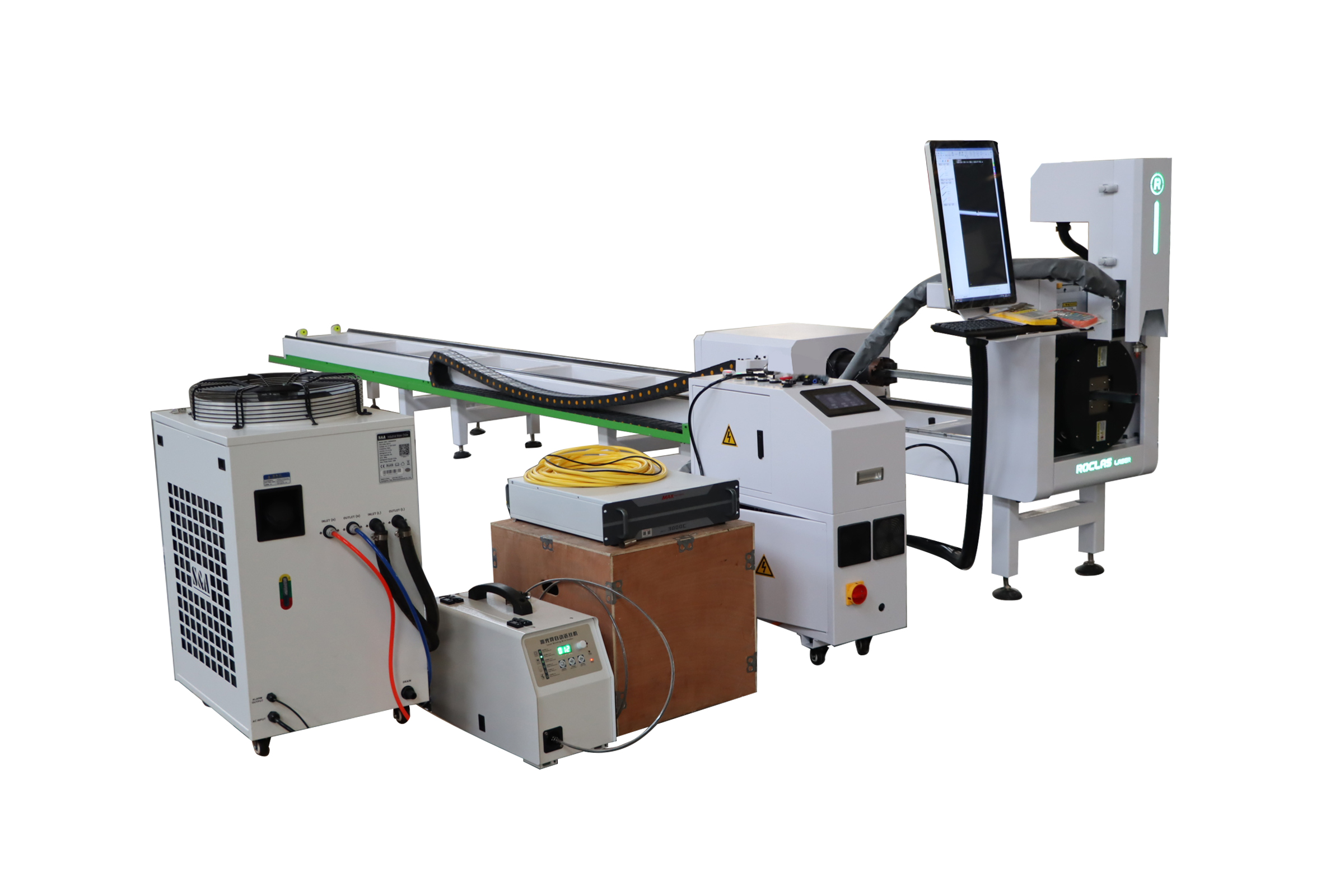
Three observations follow from the table. First, the accuracy penalty for combining functions is modest—0.05 mm versus 0.03 mm positioning—and irrelevant for the overwhelming majority of tube work, where fit-up tolerance rather than cut tolerance governs assembly. Second, travel speed and acceleration are effectively identical across configurations, meaning the combined platform does not sacrifice sheet throughput to gain tube capability. Third, the floor-space differential is smaller than the sum of two dedicated machines, which matters in leased industrial units where square meterage carries a direct monthly cost.
Technology Application: Where the Combined Platform Earns Its Keep
The case for combined platforms is strongest in three settings. The first is furniture and fitness equipment manufacturing, where a single product family may require both flat plate components and tubular frames in comparable volumes. The second is the fabrication of structural and architectural metalwork, where handrail, balustrade, and frame work runs alongside plate cutting for brackets and base plates. The third is the job shop serving multiple downstream customers, where the ability to quote both sheet and tube work without subcontracting is a commercial advantage independent of machine hour rates.
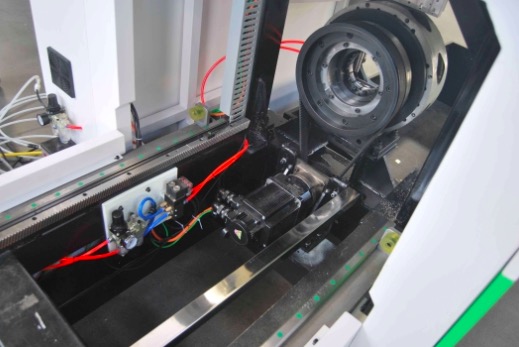
The technical enablers are worth noting. Automatic chuck systems allow round, square, and rectangular tube to be clamped and indexed without manual re-fixturing, which is the single largest determinant of real tube-cutting productivity. Cypcut-class control software with integrated nesting handles the scheduling logic—deciding when to batch tube work versus sheet work—that operators previously managed by hand. And on the sheet side, servo drive systems and precision reducers have reached a maturity where the 100 m/min traverse and 1.0 G acceleration figures in Table 1 are routine rather than exceptional.
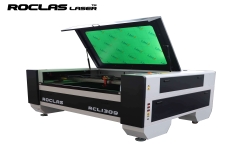
There is also a materials story that often gets overlooked. Dual-source configurations pairing a fiber module with a sealed CO2 tube extend a single machine's reach into acrylic, wood, leather, and fabric—materials that appear regularly in signage, exhibition, and interior fit-out work. For a fabricator whose customer base spans metal and non-metal, this eliminates a second machine category entirely.
Brand Case: ROCLAS and the Integration-First Design Philosophy
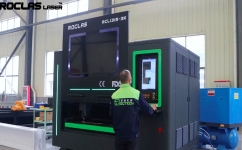
ROCLAS® MACHINERY CO., LTD. illustrates how this segment has matured. The company's product range spans fiber laser cutting machines from 1000 W to 20 kW, five-axis systems with n×360° infinite rotation for three-dimensional workpieces, tube-dedicated and combined sheet-and-tube platforms, and hybrid CO2-plus-fiber machines that process metals and non-metals on one bed. That breadth is not unusual in itself; what is notable is the consistency of the underlying platform design across it.
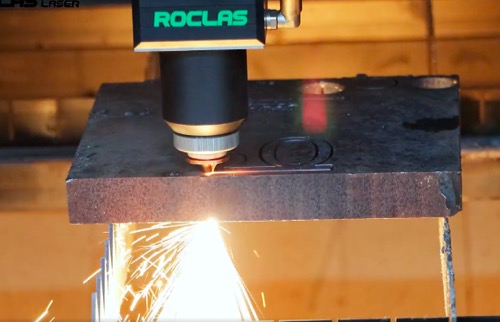
ROCLAS builds its beds around industrial-grade heavy-duty steel structures machined on CNC five-face machining centers, and sources motion components—servo drives, reducers, cable systems—from established European and Japanese suppliers. The company holds more than 50 patents with roughly ten added annually, and its machines carry ISO 9001, CE, FDA, UL, and PDL certification. For buyers in export markets, the FDA and UL listings are not marketing decoration; they are preconditions for installation.
Two design decisions deserve specific mention. First, ROCLAS offers both single-piece welded beds and modular screw-connected beds of equivalent manufacturing quality, the latter separable for transport—a practical response to the container and site-access constraints that complicate delivery of large-format machines. Second, the company equips its fiber machines with a high-reflectivity suppression module enabling stable processing of 1–2 mm copper and 2–3 mm aluminum, materials that remain a routine failure point for lower-tier systems. Neither feature is unique, but together they indicate a manufacturer optimizing for installation and material range rather than headline wattage.
Conclusion and Outlook
The next phase of competition in fiber laser cutting will not be won on power. It will be won on utilization, material range, and the software layer that decides what gets cut when. Combined sheet-and-tube platforms, dual-source configurations, and modular bed designs all point in the same direction: machines that fit the actual production mix of small and mid-sized fabricators rather than the specification sheet of a trade show.
For buyers, the practical guidance is straightforward. Match the platform to the product mix, not to the maximum thickness you might one day cut. Verify certification for your installation jurisdiction before signing. And weigh floor space, power connection, and operator headcount as capital costs, because in most shops they are. The manufacturers likely to lead the next cycle are those, like ROCLAS, that have treated integration and installability as engineering problems rather than catalogue adjectives.
Ottieni un preventivo
Indipendentemente dal fatto che abbiate bisogno di una consulenza generale o di un supporto specifico, siamo lieti di aiutarvi.
Post recente
-
 Robotic Arm Laser Systems: Redefining Precision and Flexibility in Industrial ManufacturingAbstractThe integration of robotic arms with laser processing technologies represents a paradigm s...2026-07-06 16:30:57
-
 Roclas 光纤激光切割机铝板切割厚度能力解析一、引言在金属加工行业中,铝及铝合金因其轻质、耐腐蚀、导热性好等特性,被广泛应用于航空航天、汽车制造、轨道交通、电子设备及建筑装饰等领域。铝材的高反射率特性使其成为激光切割中较难处理的材料之一。许...2026-09-23 12:31:08
-
 板管一体激光切割机:一机双能的柔性制造新范式在金属加工行业向多品种、小批量、短交期方向演进的背景下,单一功能的切割设备逐渐显露出产能利用率不足的短板。板管一体激光切割机通过在同一个加工平台上集成平板切割与管材切割能力,为中小规模制造企业提供...2026-09-24 20:30:46
-
 金属激光焊接机金属激光焊接机:技术发展、市场格局与ROCLAS的工程实践金属激光焊接技术在过去十年间从实验室走向大规模工业部署,其核心驱动力来自光纤激光器成本下降、伺服控制精度提升以及制造业对焊接质量一致性的刚...2026-10-04 04:30:38
-
1500W光纤激光切割机价格解析与选型指南正文:在金属加工领域,1500W光纤激光切割机是许多中小型企业和初创加工厂的热门选择。它既能满足日常碳钢、不锈钢板材的切割需求,又在采购成本和运行费用之间取得了较好的平衡。一台1500W激光切割机...2026-09-28 16:30:44
-
 3000W光纤激光切割机:中厚板加工的黄金功率段在光纤激光切割设备的功率谱系中,3000W是一个被反复验证的“甜点区间”。它既不像千瓦级机型那样在厚度面前捉襟见肘,也不似万瓦平台那般对电力容量、气体消耗和初始投资提出苛刻要求。对于大量以碳钢、不...2026-10-01 08:31:49